
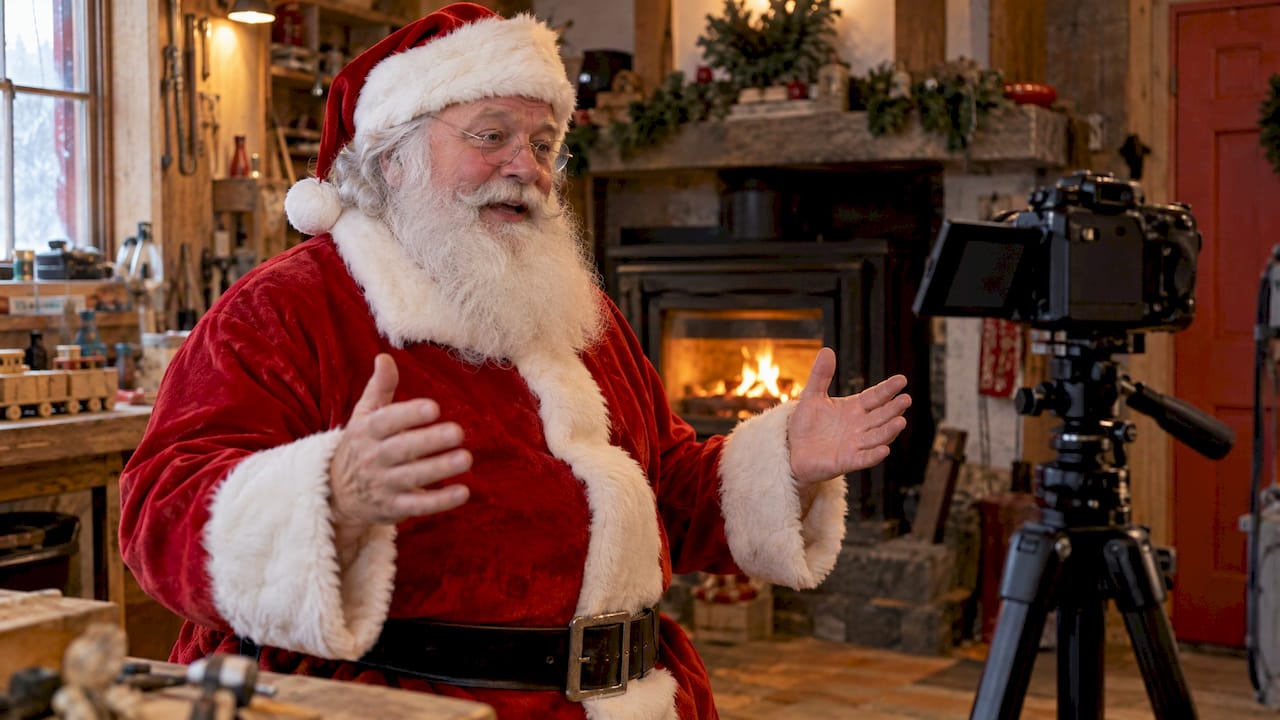
The best Christmas Eve message from Santa is short, says your child’s name out loud, mentions one thing they really did this year, and reaches them at the right moment: after dinner, before pajamas, or just before bed. You can make that with a free personalized video in a few minutes. Our free Santa video asks you four quick questions, writes Santa’s message for you to read and edit, and has Santa say it in his own voice, with your child’s name spoken aloud.
Below you will find what to put in the message, wording that suits ages 3 to 8, when to send it, how grandparents can join in, and what to check about privacy before you hand any service your child’s details.
TL;DR
- A Christmas Eve message works best at one minute or less, with your child’s name, one true achievement and one goal for next year.
- Keep promises about presents out of it. Santa can say he is proud and that the elves did their best.
- Free Santa Video turns four answers into a one-minute video you can edit before Santa records it. It is free, with no trial and no credit card, and needs no app.
- Send it on the afternoon or evening of December 24 by link, so the whole family can watch together.
- Share only a first name and a couple of details, and know what U.S. children’s privacy rules say about kids’ images and voices.
Table of Contents
- What a Christmas Eve message from Santa is for
- What to put in the message
- What not to say
- Sample wording by age
- How to send it on Christmas Eve
- For grandparents sending to grandkids
- Making it with Free Santa Video
- Free, paid or homemade: what suits your family
- Privacy: what to check before you share your child’s details
- Timing: when to plan it
- Looking for a simple alternative to the big-name Santa video sites?
- FAQ
- Sources
What a Christmas Eve message from Santa is for
On December 24 a child is already wound up. Presents are under the tree or hidden, cookies are being planned, and bedtime feels impossible. A message from Santa does three jobs at once:
- It confirms that Santa knows who they are.
- It praises something real, so the nice list feels earned.
- It gives the evening a calm, happy shape, so the excitement turns into sleepy anticipation.
That is why a generic clip of Santa waving and saying “Merry Christmas, boys and girls” falls flat with many kids. They can tell it is not about them. A message that uses the name, the year’s achievement and a goal feels like Santa has been paying attention.
What to put in the message
Think of the message as four small pieces. You do not need all of them, but the first two matter most.
The name and a warm greeting
Open with the child’s name, said by Santa, not shown as a caption. Hearing it is the moment a three-year-old sits up and a seven-year-old stops pretending not to listen. Use the name your child answers to at home, which may be a nickname.
One true thing from this year
Pick a single achievement: learning to ride a bike, reading a first chapter book, being brave at the dentist, helping a younger cousin, finally tying shoes. One specific detail beats a list of five, because a list sounds like a report card. This is also the best way to reward a child’s progress without it feeling like a lecture.
A goal for next year
Santa can gently look ahead: practicing swimming, being a kind friend in first grade, trying a new food. Keep it encouraging and small. It should sound like a wish, not a demand.
A Christmas Eve touch
This is what makes it a Christmas Eve message rather than a general hello. Santa can mention that the reindeer are getting ready, that the sleigh is packed, or that he is checking the list one last time. He can remind your child to get to sleep early so he can do his work. He can also mention milk and cookies, a long-standing Christmas Eve habit in many American homes, if your family does that.
What not to say
Some lines create problems on the morning of December 25.
- Specific presents. Do not have Santa promise a particular toy. If it is not in the pile, the whole message turns into a disappointment. “The elves worked hard on something special” is safe.
- Threats. Skip “if you are naughty tonight.” Christmas Eve is not the time for warnings, and a message that makes a child anxious defeats its purpose.
- Too many facts. A surname, a school name, an address or a long recital of the child’s week is both too much and unnecessary. A first name and two details are plenty.
- Comparisons. Do not mention siblings’ behavior in a way that ranks them.
Sample wording by age
These are our own examples, not scripts to read word for word. Change the details so they are true for your child.
Ages 3 to 4: short and cozy
At this age, aim for about half a minute of speech. Use the name, one cozy fact and one clear instruction.
“Ho ho ho, Lily! It’s Santa, and tonight is the big night. The reindeer are ready and I heard you’ve been so kind to your teddy bear. Now go to sleep nice and early, and I’ll see you very soon. Merry Christmas!”
Ages 5 to 6: a real detail and a little fun
Kids this age love being recognized for something. Add the achievement and a silly touch.
“Hello, Max! Santa here, in the workshop by the fire. I heard you learned to ride your bike without training wheels this year. What a big job! The reindeer say they’re impressed too. Next year, keep being a great helper at home. Get a good night’s sleep, and Merry Christmas.”
Ages 7 to 8: respect and a small challenge
Older kids can smell babyish language. Give them credit, a slightly more grown-up tone, and a goal that feels like a real challenge. Many kids this age are also quietly testing whether Santa is real, so a message that mentions a specific, true thing they did is more convincing than any generic clip.
“Hi, Emma. Santa here. This year you finished your first big chapter book and stood up for a friend at school, and that is exactly the kind of thing I notice. My challenge for next year: try a new sport or club, and keep that kind heart. Rest well tonight. Merry Christmas.”
A good rule of thumb: the younger the child, the shorter the message and the more it should sound like a bedtime story. The older the child, the more it should sound like a note from someone who respects them.
How to send it on Christmas Eve
Decide in advance how the message arrives, because the delivery is half the magic.
- Make it early. Do not leave it for December 24 at 7 p.m. If you start a few days ahead, you can watch it yourself first, fix any detail and save it somewhere easy to find.
- Choose the moment. After dinner or right before the bedtime routine works for most families. Some parents prefer the late afternoon, so there is still time for the excitement to settle.
- Play it on the biggest screen that is easy. A tablet on the couch, or the TV through a cast feature, makes the whole family part of the moment.
- Watch together. Siblings, parents and grandparents beside the child make it an event, not a clip.
- Save it. A video your child can watch again next year, or when they are older, is a keepsake. For more on this, see our Christmas keepsake ideas.
Because the free video is shared as a link, there is nothing to install. Grandparents far away can open it on their own phone and watch at the same time as the kids.
For grandparents sending to grandkids
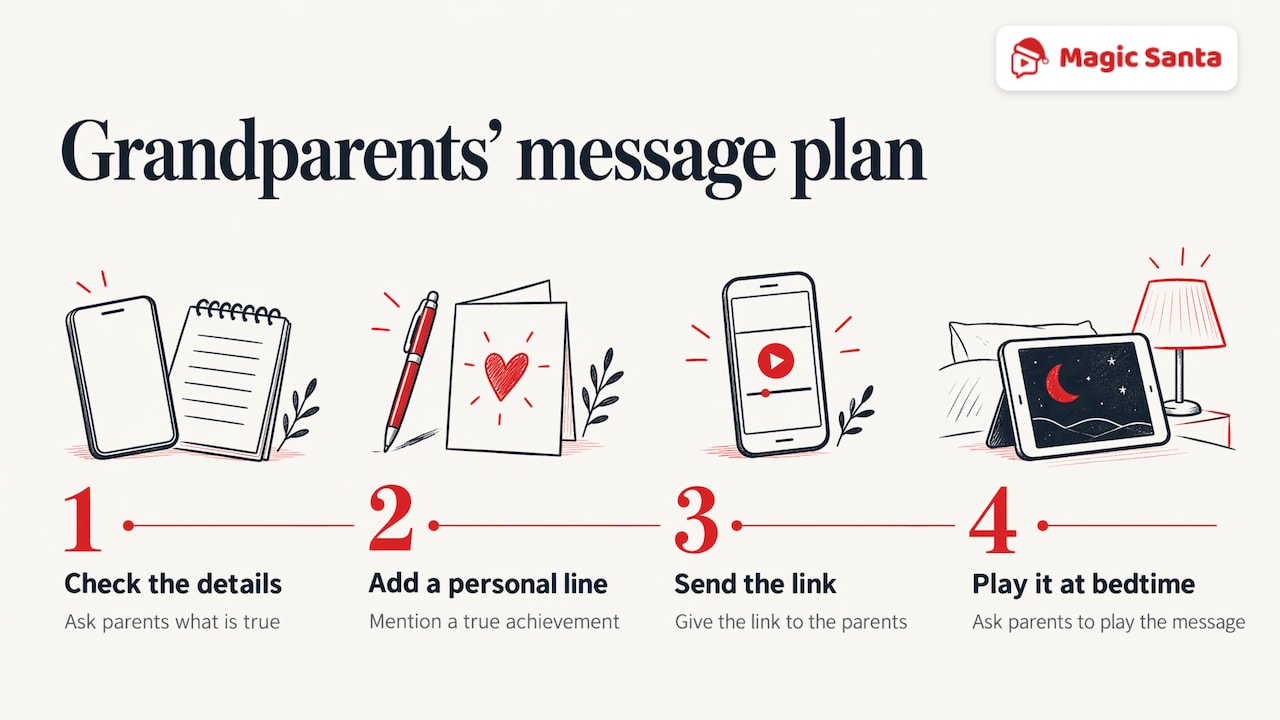
Grandparents often want to send something personal to a child they cannot hug on Christmas Eve. A Santa message is a lovely way to be part of the evening without a gift being shipped. Give the parents the link, ask them to play it at bedtime, and add a line of your own in the script: for example, Santa can say he heard the child has been a wonderful grandchild and has been missed by everyone. Ask the parents which details are true and which achievements to mention, so the message matches what the child has actually been up to.
Making it with Free Santa Video
This is the process we built for parents who want a personal message without a long production.
- Answer four questions. The child’s name, age, something they achieved this year and a goal for next year.
- Read the script. AI writes Santa’s message from your answers. You can read and edit it before Santa records it, so you can remove anything that is not right for your child.
- Santa records it. He says the message in his warm voice, in his workshop by the fire, and speaks your child’s name out loud, rather than showing it as a caption on a stock clip.
- Share the link. The one-minute video is ready in a few minutes, and the whole family can watch by link. A free Google or email account saves it. No app is needed.
The price of the standard video is $0. There is no trial, no credit card and no catch. You can start on the free Santa video page, or read more about the personalized version with your child’s name.

If you want a bigger film, the same story can become the Magic Santa Video for a one-time $7. It runs two minutes or more, shows up to 5 family photos or clips on Santa’s TV, uses a 3D animated style and comes as a 1080p download. It is a single purchase, not a subscription. You can find it on the same Santa video page.
Free, paid or homemade: what suits your family
Families reach this keyword with different budgets and different appetites for effort. Here is how the options compare on what matters most on December 24.
| Need | Free Santa Video | Magic Santa Video |
|---|---|---|
| Cost | $0 | $7 one-time |
| Length | About one minute | Two minutes or more |
| Child’s name spoken by Santa | Yes | Yes |
| Script you can edit before recording | Yes | Yes |
| Family photos or clips | No | Up to 5, on Santa’s TV |
| Style and download | Share by link | 3D animated style, 1080p download |
For a child of 3 to 5, the free one-minute video is usually exactly the right size, because a short message holds a small child’s attention. For a child of 6 to 8, or for a family that wants to put in Christmas photos, the longer film gives more to look at. If you have several children, make one video per child so each gets their own name and achievement.
Privacy: what to check before you share your child’s details
Any service that makes a personalized video asks for some information about your child. That is normal, and it is reasonable to keep it small.
In the United States, the Children’s Online Privacy Protection Rule, known as COPPA, applies to commercial websites and online services directed to children under 13 that collect personal information from them. The FTC’s own guidance explains that the rule treats photos, videos and audio recordings containing a child’s image or voice as personal information. It is also the reason many families are careful about what they upload.
Three habits keep you comfortable:
- Use a first name. A message does not need a surname, a school, a street or a birthday.
- Stick to a couple of details. An achievement and a goal are enough for a warm message.
- Know who is entering the information. On Free Santa Video, the parent answers the questions. The child does not need an account or to type anything.
If a child asks how Santa knew about the bike or the book, you can say, “Santa has his ways, and the elves hear a lot.” Decide on your answer before the video plays.
Timing: when to plan it
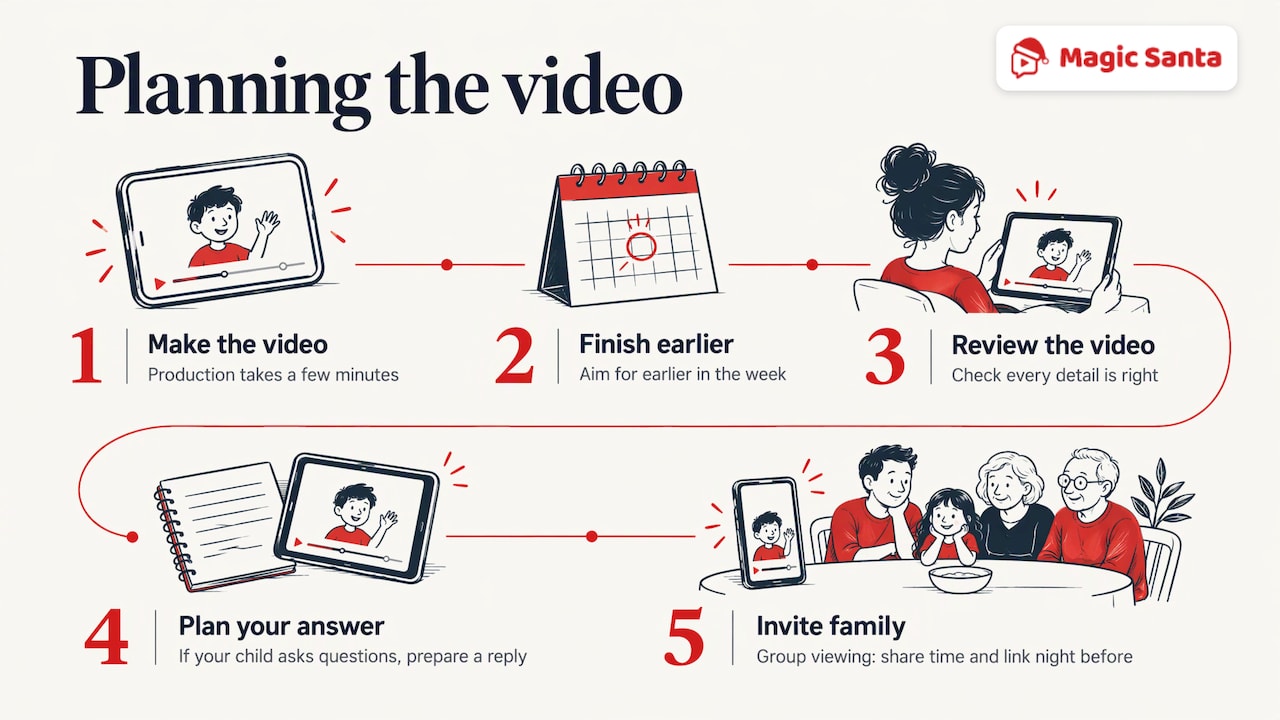
The free video takes a few minutes to produce, so it is a fine last-minute Christmas Eve idea. Even so, we suggest finishing it earlier in the week, so you can watch it first and check that every detail is right. If your child is old enough to ask questions, have a plan for what to say. If you want the whole family to watch together, tell grandparents and cousins the time the night before, and send the link.
If you want more ideas for the build-up, you can read our Santa voice message guide or our post on the North Pole Santa video. For parents who want gifts with lasting meaning alongside the video, our list of meaningful Christmas gifts for kids 3 to 8 is a good companion.
Looking for a simple alternative to the big-name Santa video sites?
Many parents come to us because they want a Santa message without a long set-up or a bill. Free Santa Video is built for that: four answers, an editable script, Santa saying your child’s name and a link you can share with the family. If you later decide you want the longer film with photos, it is a one-time $7, not a subscription. Start at freesantavideo.com.